Import
Frida Kahlo is undoubtedly one of the most influential and recognizable figures in the history of world art. The case of the Mexican artist is as unique as her work, ideology and personality. These elements are so closely intertwined that understanding one requires delving into the other. Although her fictional, full of twists and turns, her life often overshadows her purely artistic identity, Kahlo's true value lies in her ingenious style.
She managed to transmute her personal trauma and national identity into a universal visual language, redefining the boundaries of contemporary art. We could say that she was the painter of physical pain. Despite her personal hardships, her works are distinguished by the will to live, acquiring a contradictory character.
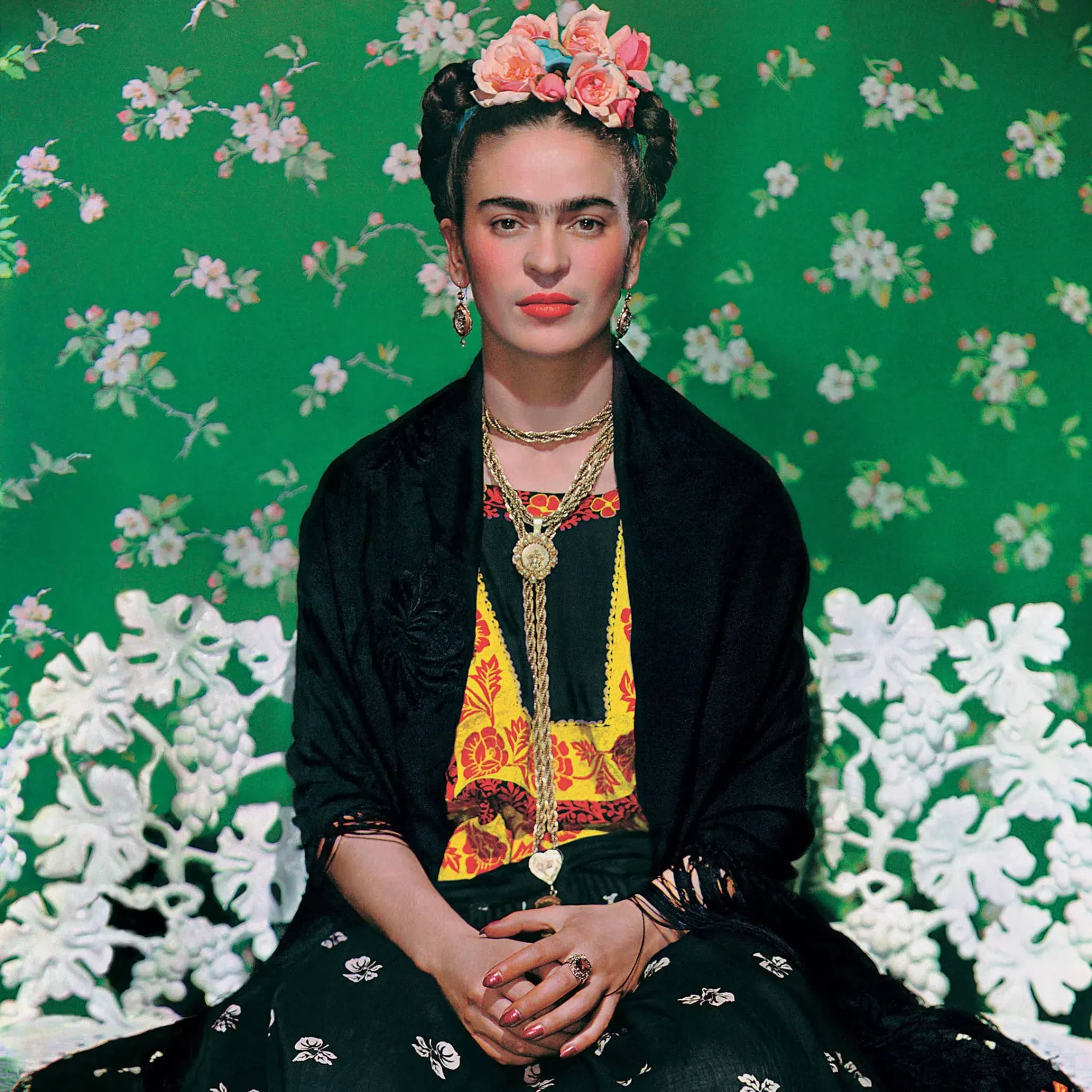
Table of Contents
The formation of an unconventional personality
Born in 1907 in Coyoacan, Mexico, Magdalena Carmen Frida Kahlo y Calderón shaped her character through the physical ordeal and social upheaval of the Mexican Revolution. She later changed her birth year to 1910 to coincide with the year the revolution began, a move indicative of her politicized nature. Polio at age six and a near-fatal bus accident at eighteen left her with permanent disabilities and required dozens of surgeries. This physical fragility, however, was offset by an indomitable and strong spirit.
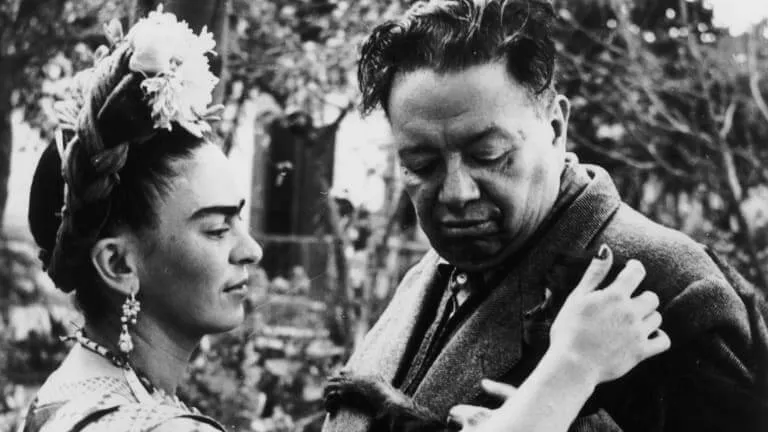
A defining factor in her life was her stormy marriage to the leading Mexican muralist Diego Rivera. Their relationship became the central emotional axis of her existence and a key source of inspiration for her work, fueling her art with rawness and emotion.
The special style
Kahlo's painting refuses to be confined to narrow artistic molds. Although André Breton, founder of Surrealism, sought to integrate her into the European movement by characterizing her work «"a ribbon around a bomb"», she herself separated her position. Her statement «"I don't paint dreams. I paint my own reality"» accurately captures the essence of her style.
Frida Kahlo's art is characterized by a raw honesty that often shocks the viewer. Of her approximately 143 paintings, 55 are self-portraits. As she herself stated: «"I paint myself because I am so often alone and because I am the subject I know best"».
Her visual language is recognized by three basic building blocks:
- The influence of Retablos and Ex-votos
Frida Kahlo was deeply influenced by Mexican folk religious art. She often painted on small metal surfaces (such as tin), adopting the naive perspective, two-dimensional structure, and dramatic narrative of traditional votive offerings. This technique allowed her to bring a sense of sacredness as well as a direct, folk honesty to her personal suffering.
- Mexicanidad (Mexicanness)
Her work is steeped in pre-Columbian art, Aztec mythology, and Mexican folklore. Her choice to wear and depict traditional “Tehuana” clothing, elaborate jewelry, and flowered hairstyles in her paintings was not a simple aesthetic preference. It was a conscious political statement of anti-colonialism and cultural independence, at a time when the Mexican elite looked exclusively to Europe.
- Symbolic and anatomical realism
Kahlo used an almost microscopic, meticulous precision in her brushwork, which she combined with hard, anatomical elements. The experience of dozens of surgical operations led her to incorporate medical instruments, internal organs, open wounds, and blood into her work. These elements functioned not as means of impressing, but as an internal psychological code, where the body becomes a canvas of human suffering.
Frida Kahlo's value lies in her ability to metabolize trauma into high aesthetics, creating a visual language that speaks directly to the human soul, beyond temporal and spatial boundaries.
Presentation of emblematic works
Frida Kahlo's complex universe is crystallized through her work, which consists of approximately 143 paintings, of which 55 are self-portraits. The following paintings are milestones in her artistic journey.
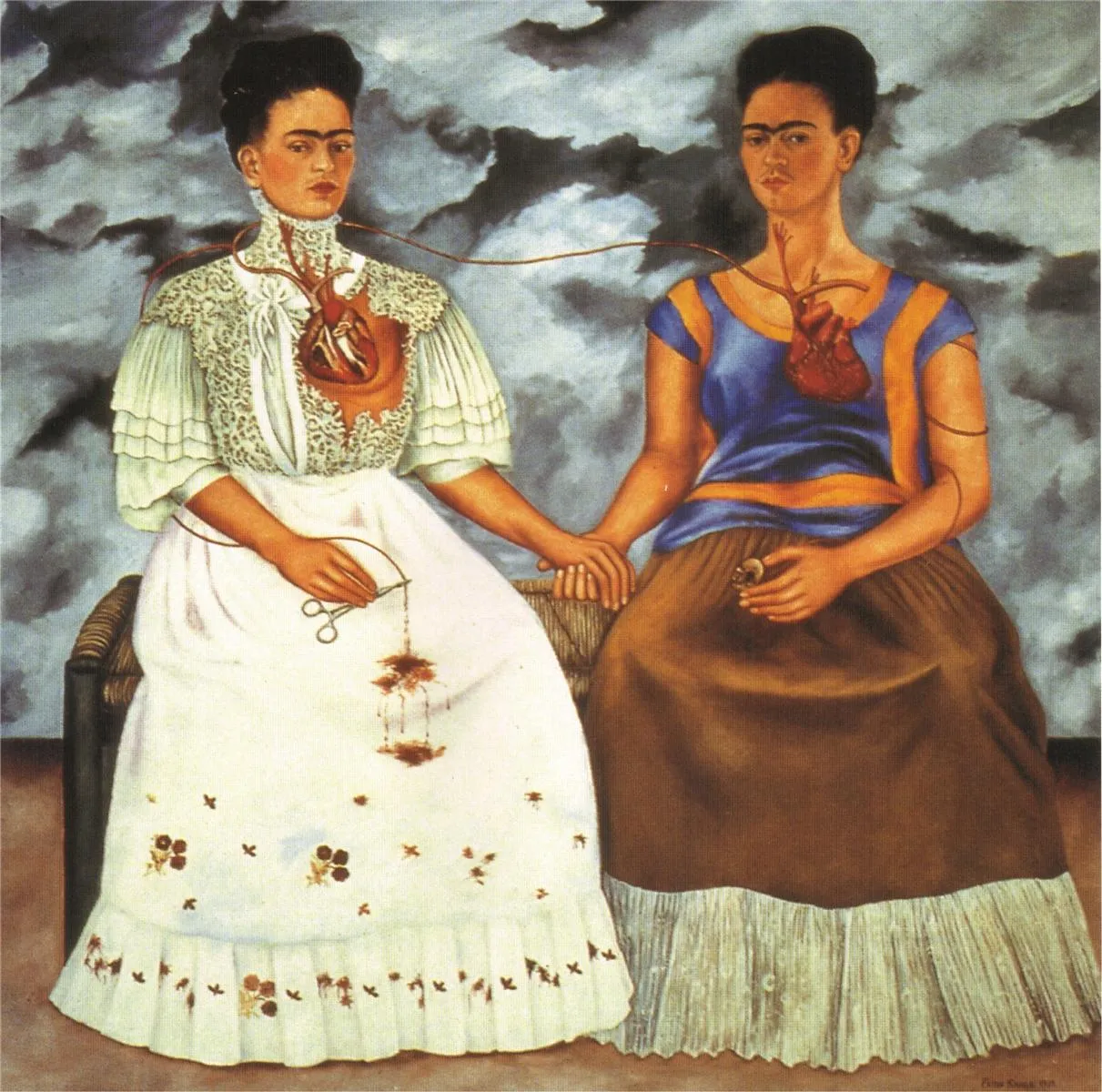
«"The Two Fridas" (Las Dos Fridas, 1939)
It is her largest and most recognizable work, created during her painful divorce from Diego Rivera. The painting is a deeply psychological study of the split personality and cultural identity.
- The European Frida: On the left, Frida is depicted in a Victorian white wedding dress, a nod to her father's European heritage. This version of her holds a pair of surgical forceps with which she has cut an artery, causing bleeding into her dress. She represents the woman rejected by Rivera.
- The Mexican Frida: On the right is Frida in traditional Tehuana costume, the version that Rivera loved deeply. In her hand she holds a small locket with a photograph of Diego as a child.
- The Connection: The two figures sit on a bench, holding hands, their hearts exposed and visible above their clothing. A single artery connects the two hearts, starting from Rivera's pendant and ending in the bleeding European Frida. The dark, cloud-filled background intensifies the sense of existential anguish and loneliness.
«"The Broken Column" (La Columna Rota, 1944)
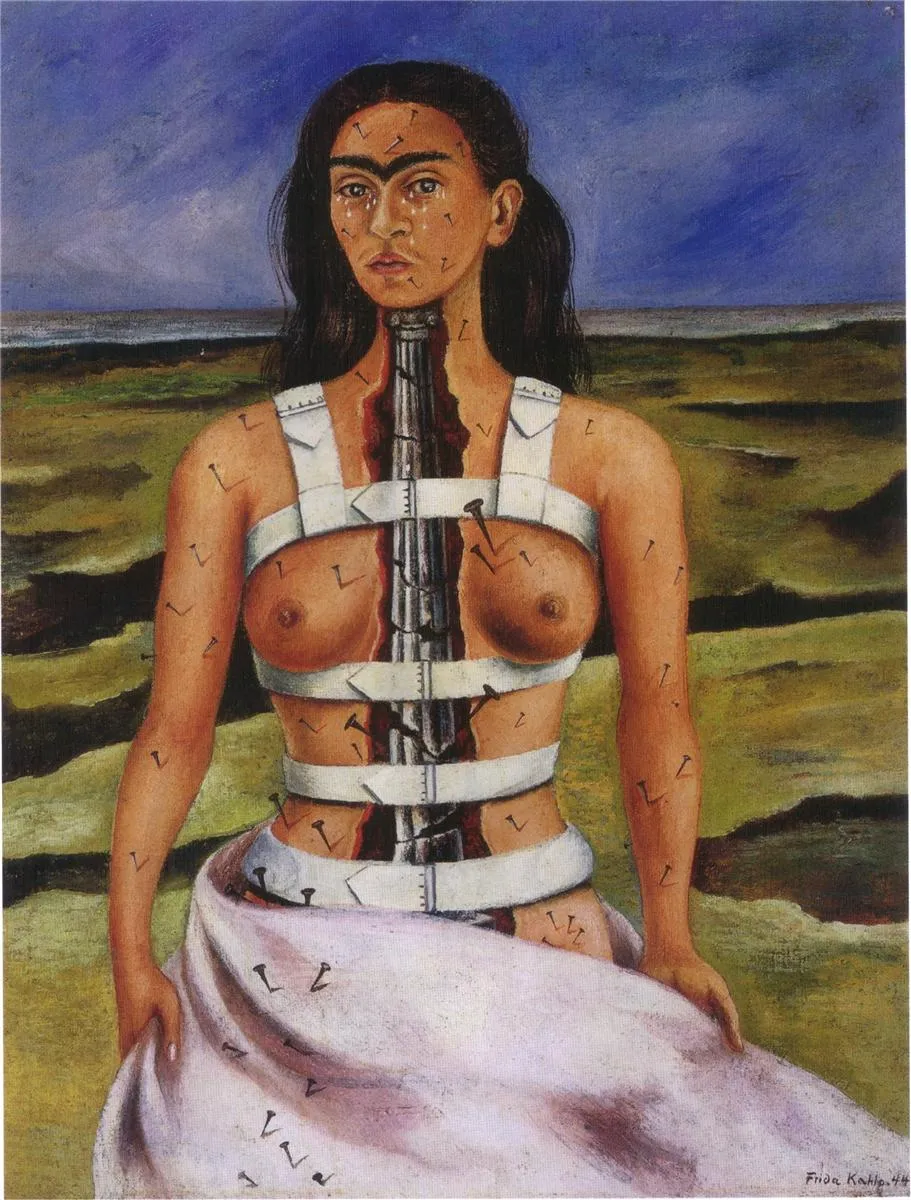
This table constitutes the absolute visual representation of physical pain and at the same time, of human pride. It was created after a serious spinal operation, during which Frida Kahlo was forced to wear a metal corset for months.
The painter presents herself naked from the waist up, her body split in two along a surgical incision. In place of the spine is a cracked Ionic column, a clear reference to classical architecture on the verge of collapse. Her body is held together with difficulty by the white straps of a medical corset.
Dozens of nails are driven into her skin, as well as into the fabric covering her hips, symbolizing the constant, sharp pain she felt every day. A large nail is placed directly over her heart, suggesting emotional pain. Despite the tears streaming down her cheeks, her gaze remains steadfast, haughty, and defiant, refusing to ask for pity. The dry, cracked landscape in the background reflects her own physical condition.
«"Viva la Vida" (1954) – The ultimate joy in life
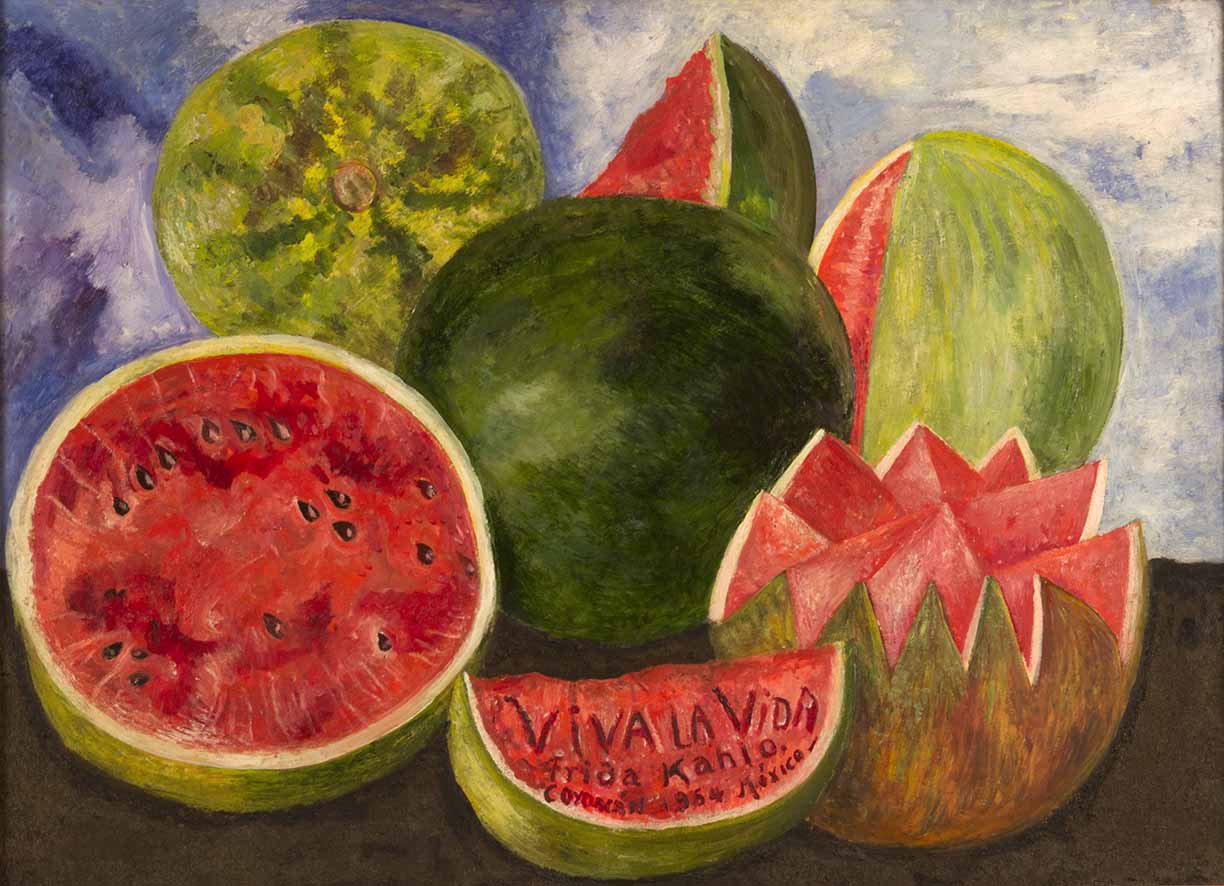
The table «"Long Live Life"» (Long Live Life) holds a shocking place in Frida Kahlo's oeuvre, as it is considered the last work she signed, just eight days before her death in July 1954. It is a still life with watermelons, a fruit with strong symbolism in Mexican culture and especially on the Day of the Dead (Day of the Dead), where it symbolizes the connection of the living with their ancestors.
- The contrast of colors and shapes: Watermelons are depicted in various states all together, sliced, with bright red flesh contrasting with the green of the rind. The red refers to blood and vitality, while their spherical shape refers to fertility.
- The engraved message: On the deep red flesh of a slice at the bottom of the painting, Kahlo engraved with a brush the words: «"VIVA LA VIDA – Coyoacán 1954 Mexico"».
- The symbolism of the end: Despite her failing health and unbearable pain, choosing to bid farewell to the world not with a dark self-portrait but with an explosion of color and a hymn to life is the ultimate act of stoicism. The watermelon, though cut and exposed (like her own body), remains sweet and full of seeds, a promise of rebirth.
Cultural heritage and modern influence
Frida Kahlo was a dynamic artist with a strongly political stance, an element that is evident in many of her works. Her intense personal life combined with physical and mental trauma from an early age, shaped a multifaceted character with a deep psychological identity. On the one hand, her frail physical nature clashed with an unruly and unyielding spirit, thus creating a unique blend of artistry.
Frida Kahlo was not just an autobiographical painter of the last century, but a radical pioneer who redefined the place of women in the history of art. She used the female body and its experience not as an object of male desire or beautiful depiction (as was customary in the Western, patriarchal tradition), but as a subject of experiential, political and existential search. She spoke openly about topics that were taboo, such as elimination, the infertility, the menopause and the family grief.
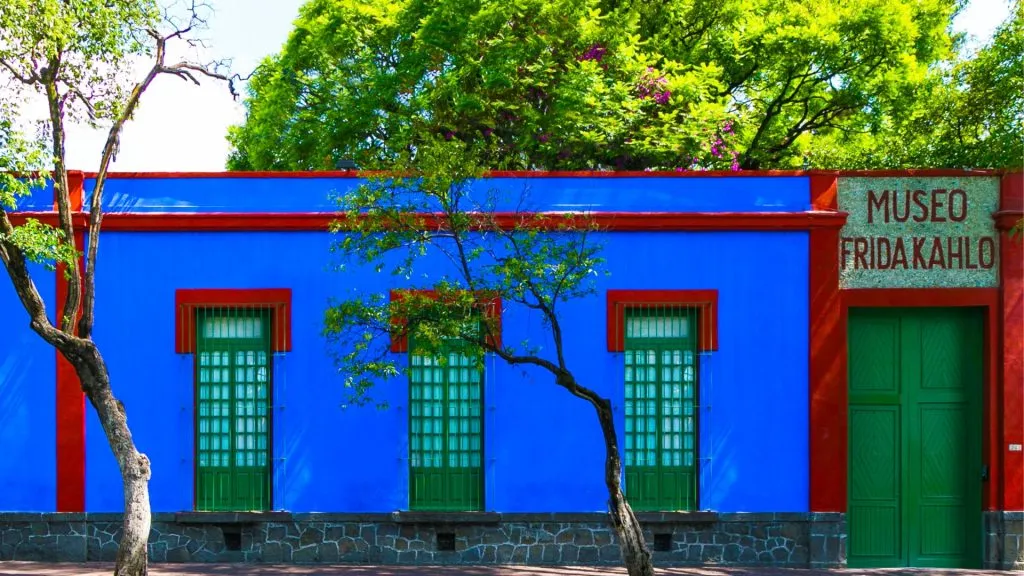
The “Blue House” (Casa Azul) in Mexico, where she lived and died, remains a pilgrimage for millions of people seeking the truth behind the myth. Frida Kahlo was not just a painter, she was a visionary who managed to make the personal universal, proving that art is the ultimate tool for survival and self-definition.