Import
If symmetry and imperfection determine how we feel about a work, then the geometry is what determines the way it stands. Behind many compositions that we consider harmonious, there is an invisible structure that is not immediately perceived, but deeply affects the viewer's experience. From the Fibonacci sequence until Golden Ratio, art seems to converse with mathematics in more substantial ways than we think.
However, this perfect geometry does not work with absolute precision. As we saw in the previous article about symmetry, the real power of art is often found in the deviation from perfection. Geometry is not imposed on the work, it functions as a background on which the expression develops.
Contentsa
The Fibonacci sequence as a natural pattern
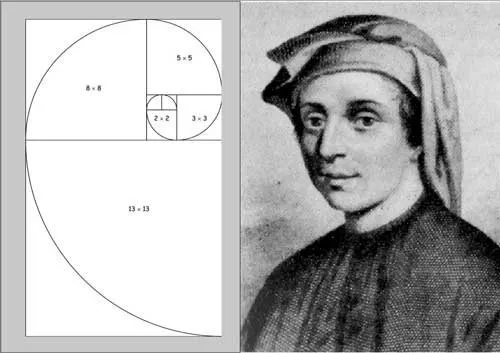
The Fibonacci sequence is a mathematical sequence that starts with the numbers 0 and 1, and each subsequent term is the sum of the two previous ones (0, 1, 1, 2, 3, 5, 8, 13…). What makes it particularly interesting is not only its numerical structure, but the fact that it appears frequently in nature.
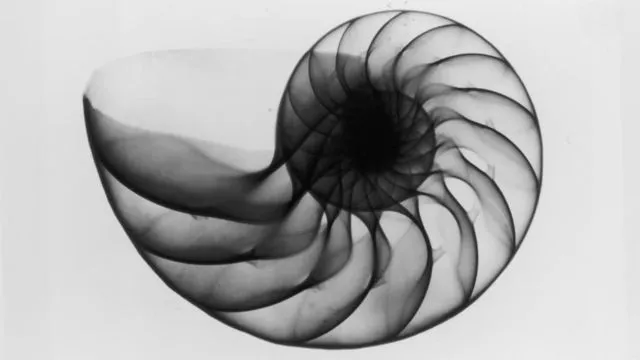
Introduced by Leonardo of Pisa in 1202, originally to describe the reproduction of rabbits. But its significance extends far beyond that, as the ratio of two consecutive numbers tends towards the «golden ratio» (1.618). This mathematical harmony appears strikingly in nature, from the arrangement of flower petals to the spirals of seashells, and is now widely used in computer science, cryptography, and market analysis.
In art, this sequence translates into a sense of natural flow. Artists don't need to know mathematics to apply it. They often approach it intuitively. When a work follows this logic of development, the viewer perceives it as smooth and pleasant, even if they can't explain why.
Golden Ratio: The perfect harmony
The Golden Ratio is considered by many to be the ideal proportion. It is a mathematical relationship that has been associated with aesthetic harmony in works of art, architecture, and design. The idea is that when the elements of a composition follow this proportion, the result appears more balanced. The golden ratio also known as golden ratio, golden rule ή divine analogy is an irrational number represented by the letter φ (in honor of the sculptor Phidias) and is approximately equal to 1,618. It is considered the mathematical key to absolute harmony and beauty.
An often cited example is the use of the golden ratio in Renaissance works, such as those by Leonardo da Vinci. Although there is not always absolute proof that it was applied consciously, the composition of many works shows a tendency towards these proportions. This reinforces the idea that harmony is not accidental, but the result of a deeper structure.
Geometry as an invisible guide
Geometry in art does not function as a rule to be strictly followed, but as a kind of skeleton. The viewer does not see the golden ratio or Fibonacci directly, but feels the result of their application. The composition acquires coherence, the gaze is guided, and the work acquires a sense of balance.
Here lies the essence: geometry is effective when it remains invisible. When it becomes obvious or used mechanically, the work loses its vitality. Art is not a mathematical equation, it is an experience.
The imperfection within the perfect structure
Despite the apparent perfection of these mathematical models, their actual application in art always involves deviations. No work follows Fibonacci or the golden ratio perfectly. It is these small deviations that create interest.
As we analyzed in article about symmetry and imperfection, the brain does not seek absolute balance, but the tension that arises from deviation. Geometry provides the basis, but imperfection gives life. Without it, the work risks looking too “correct” and ultimately, indifferent.
Modern art and geometric influence
In modern times, geometry continues to influence art, but often in a more indirect way. In digital art and design, rules of composition are often based on proportions reminiscent of the golden ratio, even if they are not explicitly stated.
At the same time, the overuse of perfect templates and grids has led to a uniformity that is becoming increasingly apparent, especially on platforms like Instagram. This is directly related to the question we will examine in the next article: why so many works look alike and how the aesthetics of the algorithm affect creativity.
Conclusion
Geometry in art is not just a technical tool, but a way of organizing experience. The Fibonacci sequence and the Golden Ratio offer a framework within which harmony can develop, but they do not guarantee it.
Ultimately, the true power of a work lies not in the faithful application of mathematical rules, but in the relationship between structure and deviation. Harmony is not the result of perfection, but of a balance between the predictable and the unpredictable.
In a future article, we will see why despite all these principles, many contemporary works seem to follow the same patterns and why art on social media seems increasingly uniform.